Ads 468x60px

Sunday, December 2, 2012

The Lighthouse of Alexandria-Egypt


The Lighthouse of Alexandria is on the ancient island of Pharos, now a promontory on the harbor of the city of Alexandria in Egypt.This light house of Alexandria was one of the useful wonders among all the seven wonders of the world (for the sailors to return to the Great Harbor). This is a small point that differentiates it from the rest of the wonders of the world. The mirror which was mounted on this lighthouse could reflect the light more than 35 miles off-shore. Of the 6 ancient destroyed wonders, this was the last to be destroyed around 1480 AD.This lighthouse was built around 280 BC and was around 134 m in height. This was built in the city of Alexandria.
The light house had a good mirror which can reflect the sun light to a very long distance. Mythical stories used to say that this mirror was used to burn the enemy ships.
The Macedonian conqueror, Alexander during his successful reign, had tried establishing approximately 17 cities in the name of Alexandria. The only one survived long was the one in Egypt. That too even this city was not completely built by Alexander. The completion of the construction of this city was achieved by his commander Ptolemy I Soter.
Ptolemy connected Alexandria to the Pharos island by a bridge. It was realized that the sailing in this coastal region is very dangerous. That is why he decided to build a light house. This project was initiated during Ptolemy's reign in 290 BC and completed after his death by his son Ptolemy Philadelphus. Sostratus who lived in the same time as Euclid, was the architect. This used to remain in the harbor for centuries. This wonder of the world also depicted in the Roman coins that time.
The writings of the Arab conquerors are very good source of information about this lighthouse. The new rulers moved the capital to the Cairo. So this place had lost its importance. Three earthquakes stuck in various periods (around AD 956, AD 1303 and AD 1323 ) have damaged the lighthouse significantly. The during AD 1480 the Egyptian Mamelouk Sultan, has built a medieval fort at the same place. That was the end to the story of the light house.
After he invaded Rodes with 40,000 soldiers as good as eventually completed feat after most attempts, Demetrius as the pointer of feat combined the Colossus Of Rodes. It is the 60 feet high sature of Zeus station upon the white marble pedestal nearby the Mandraki harbour. The make up was done in iron as good as bronze. It took twelve years to finish the statue as good as was broken in an Earthqake inside of 56 years.


The Colossus of Rhodes was a statue of the Greek god Helios, erected in the city ofRhodes on the Greek island of Rhodes by Chares of Lindos between 292 and 280 BC. It is considered one of the Seven Wonders of the Ancient World. Before its destruction, the Colossus of Rhodes stood over 30 meters (107 ft) high, making it one of the tallest statues of the ancient world. Alexander the Great died at the early age of 32 in 323 BC without having had time to put into place any plans for his succession. Fighting broke out among his generals, the Diadochi, with four of them eventually dividing up much of his empire in the Mediterranean area. During the fighting, Rhodes had sided with Ptolemy, and when Ptolemy eventually took control ofEgypt, Rhodes and Ptolemaic Egypt formed an alliance which controlled much of the trade in the eastern Mediterranean.Ancient accounts, which differ to some degree, describe the structure as being built with iron tie bars to which brass plates were fixed to form the skin. The interior of the structure, which stood on a 15-meter- (50-foot-) high white marble pedestal near the Mandraki harbor entrance, was then filled with stone blocks as construction progressed. Other sources place the Colossus on a breakwater in the harbor. The statue itself was over 30 meters (107 ft) tall. Much of the iron and bronze was reforged from the various weapons Demetrius's army left behind, and the abandoned second siege tower was used for scaffolding around the lower levels during construction. Upper portions were built with the use of a large earthen ramp. During the building, workers would pile mounds of dirt on the sides of the colossus. Upon completion all of the dirt was removed and the colossus was left to stand alone. After twelve years, in 280 BC, the statue was completed. Preserved in Greek anthologies of poetry is what is believed to be the genuine dedication text for the Colossus.

The Temple of Zeus-Olympia


The Temple of Zeus at Olympia is one of the earliest examples of fully developed temple design in Greece, and is considered a model of Doric temple architecture (N. Yalouris). The temple was designed by local architect, Libon of Elis, and constructed between 470 BC – 456 BC to commemorate the Elean defeat of the Pisatans in 470 BC.
The hexastyle temple was constructed of local limestone, and coated with stucco. Its dimensions stretched 64.12 x 27.68 m, with six columns at each end and thirteen columns along each side. The columns were 10.43 m high and slightly tapered, measuring 2.21 – 2.25 meters in diameter at the base and 1.68 – 1.72 meters in diameter at the top. They had 20 flutings around the shaft, three incised rings around the neck, and four rings around the capital. The architrave and triglyph freize were large and colorful; paint traces suggest that the upper band of the architrave was red, and the metopes blue (E. Gardiner). The roof was originally tiled with Parian marble slabs, but these were replaced during Roman times with Pentelican marble (E. Gardiner). A continuous marble sima supported the roof, interrupted only by lion’s head water spouts. The 39 mostly intact lion’s heads found at the temple are of varying styles and material; this suggests the temple underwent constant repairs and upkeep until it was destroyed by earthquake in the 5th century AD.

The Great Pyramid Of Giza-Egypt


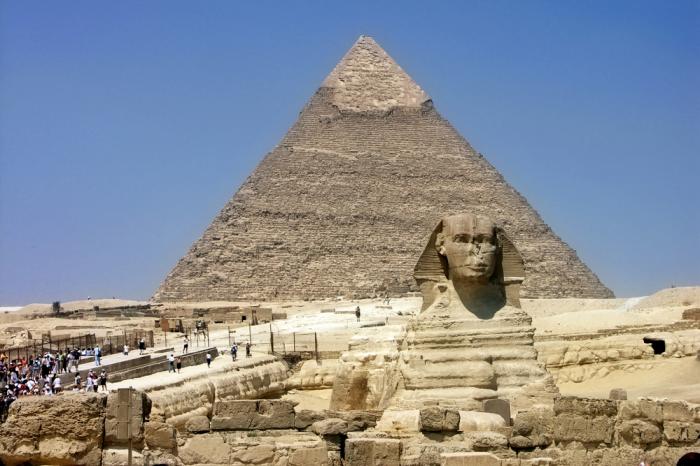
Khufu, or Cheops, built his pyramid on the Giza plateau, where he found firm bedrock and a convenient limestone quarry. His pyramid is a work of astonishing size and precision, standing 481ft (146.6m) high, with a slope of 51 degrees 50'. Its sides vary by less than 1.9ft (58cm) and are orientated almost exactly true north. Its base is almost completely level. It has been calculated that the base of the Great Pyramid could accommodate both the UK Houses of Parliament and St Paul's Cathedral with room to spare.
The pyramid holds three chambers linked by a system of passageways: the unfinished 'Subterranean Chamber'; the ill-named 'Queen's Chamber'; and the 'King's Chamber', where Khufu was buried in an enormous, plain, red granite sarcophagus.

Saturday, October 13, 2012

Mount Roraima


Mount Roraima
Venezuela, Brazil and Guy


Mount Roraima is a pretty remarkable place. It is a tabletop mountain with sheer 400-metre high cliffs on all sides. There is only one ‘easy’ way up, on a natural staircase-like ramp on the Venezuelan side – to get up any other way takes and experienced rock climber. On the top of the mountain it rains almost every day, washing away most of the nutrients for plants to grow and creating a unique landscape on the bare sandstone surface. This also creates some of the highest waterfalls in the world over the sides (Angel falls is located on a similar tabletop mountain some 130 miles away). Though there are only a few marshes on the mountain where vegetation can grow properly, these contain many species unique to the mountain, including a species of carnivorous pitcher plant.
 

Total Pageviews


Join us in Facebook. Just Click the Like Button Below

Powered By EXEIdeas